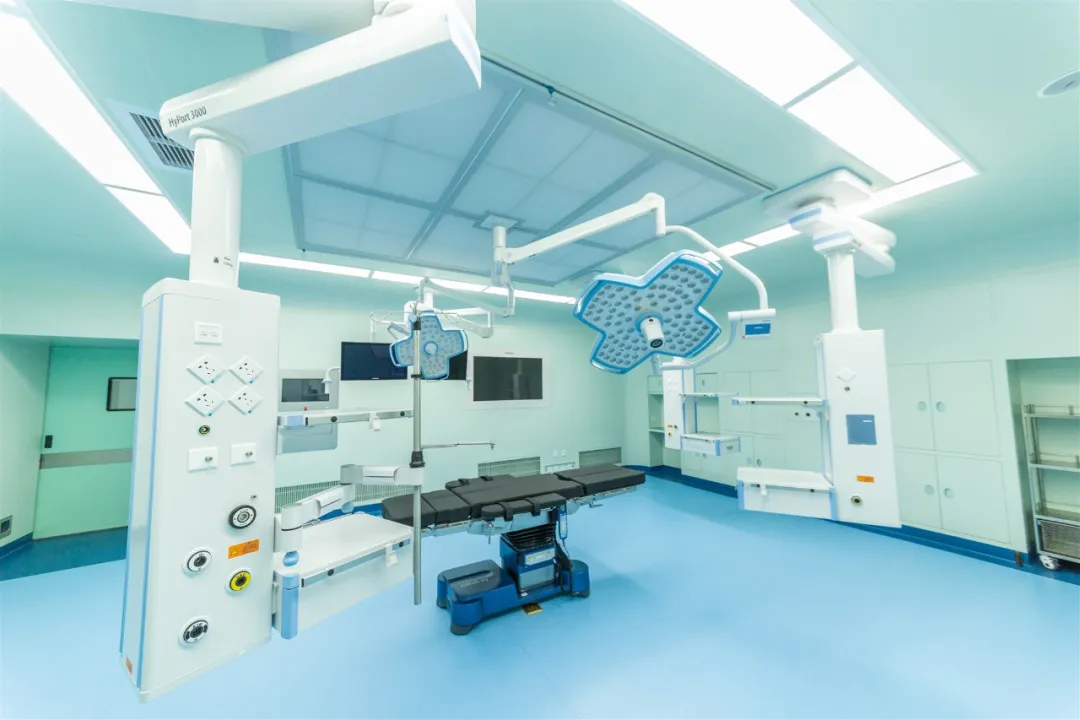
As 5G, AI, and cloud technologies continue to mature, the “smart hospital” has become a major focus in hospital planning, construction, and related research. Alongside advanced buildings, medical equipment, and clinical capabilities, an efficient hospital logistics system is now a basic requirement for modern smart hospitals. Smart logistics transport, in particular, is a key component of hospital operations and an integral part of modern healthcare facilities.
This article examines how smart logistics transport systems influence hospital spatial forms and, based on practical cases, proposes key architectural design points and optimization suggestions.
1. Hospital Spatial Forms Under the Influence of Smart Logistics
Hospital layouts are typically categorized as centralized, semi-centralized, or decentralized. With the large-scale adoption of smart logistics systems, hospital planning is increasingly organized around circulation. Many newly built large hospitals in China adopt a semi-centralized layout. To meet the needs of smart logistics—such as continuous space, clear circulation, and concentrated core functions—these layouts are generally developed into three main architectural forms: axial, circular, and grid-based.
1. 1The Axial Layout (Hospital Street)
The axial layout is centered on a linear circulation space that links outpatient, medical technology, inpatient, and support functions in a series—commonly known as the “hospital street.” This street serves as the main artery, efficiently directing people flow, material flow, and smart logistics to different departments, forming an integrated circulation system.
Logistics advantage: The hospital street is the core operating zone for smart logistics. Transport tracks, empty cart parking areas, and robot corridors can all be integrated along this spine without the need for separate routes. Deliveries branch out from the main line, creating a simple, clear, and efficient distribution pattern.
Case study: The First Affiliated Hospital of Sun Yat-sen University (Nansha) is a typical example. It adopts a double hospital street layout. A north–south main street connects the medical, research, office, and international healthcare zones, concentrating logistics equipment and routes. Dedicated robot corridors avoid conflicts with basement vehicle traffic and improve efficiency. East–west secondary streets mainly use track-based logistics systems to connect outpatient, emergency, medical technology, and inpatient areas. The campus primarily relies on track and robotic systems, with pneumatic systems as a supplement. A smaller number of robots are also used within the medical zone to serve the pharmacy, operating rooms, and wards.
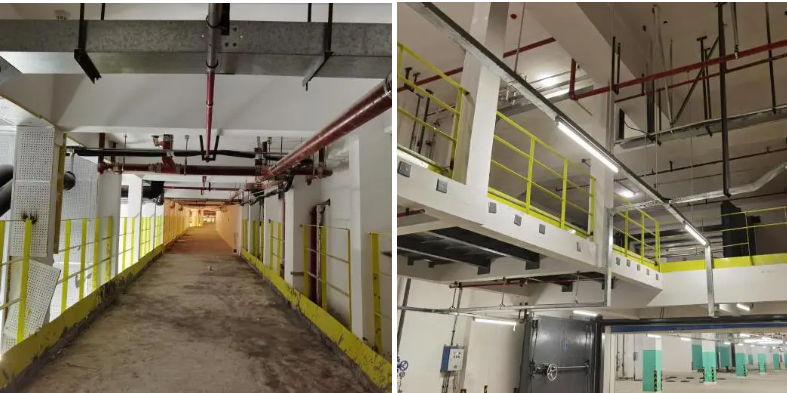
Dedicated Robot Logistics Corridor
1.2 The Circular Layout (Central Core)
In a circular layout, functional departments are arranged around a central space, which may be a landscaped courtyard or a functional core such as a circulation or medical-technology hub. Outpatient, medical technology, inpatient, and administrative/support areas are connected by internal streets, corridors, and platforms, forming a closed-loop configuration.
Logistics advantage: This can be understood as an axial layout whose ends are connected to form a loop. Smart logistics can operate in continuous circulation. The spaces linking different functional blocks can also serve as buffer zones for equipment rooms and empty cart areas. The circular distribution pattern improves operating intensity and equipment utilization.
Case study: Foshan Women and Children’s Hospital is organized around a sunken central courtyard. The south side includes leisure, administrative, and research areas; the west side houses medical technology; the north side contains inpatient wards; and the east side accommodates outpatient services—together forming a full ring. The hospital uses pneumatic, box-type, and robotic logistics systems. The box-type system mainly connects the pharmacy, IV admixture center, clinical departments, inpatient wards, and laundry. Stations are vertically aligned, using horizontal or vertical dual-track openings for vertical transfer. No special opening size is required beyond fire code compliance. A horizontal transfer level on the fifth-floor roof enables cross-building transport.
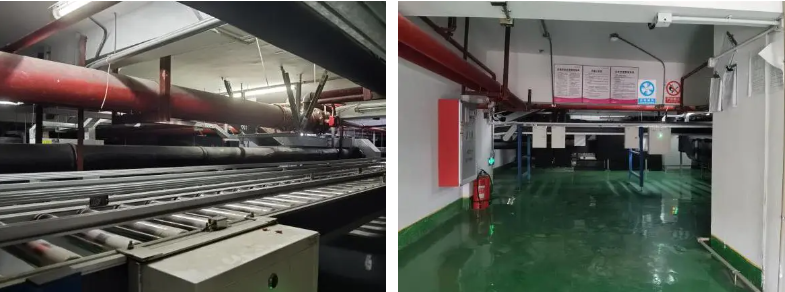
Transfer Floor
1.3 The Grid Layout (Modular Units)
The grid layout is based on an orthogonal circulation network, usually with a central traffic core and modular functional blocks arranged around it. Modules can be organized either by function (outpatient, medical technology, inpatient, research/office) or by a multi-center model where each unit contains a mix of functions.
Logistics advantage: This layout allows multiple circulation systems, making it easier to separate patients and staff as well as clean and dirty flows. Smart logistics can operate through secondary circulation routes, and each module can have its own dedicated system. The grid-style distribution supports multi-stage transport and helps avoid congestion caused by complex functional clustering.
Case study: Fuwai Hospital of the Chinese Academy of Medical Sciences (Shenzhen) divides the campus into five functional modules. Outpatient, emergency, and medical technology services are distributed across four podium modules, while inpatient wards are arranged in towers above. The modules are connected through atrium hubs and secondary corridors, with courtyard spaces in between. The hospital mainly uses a track-based logistics system.
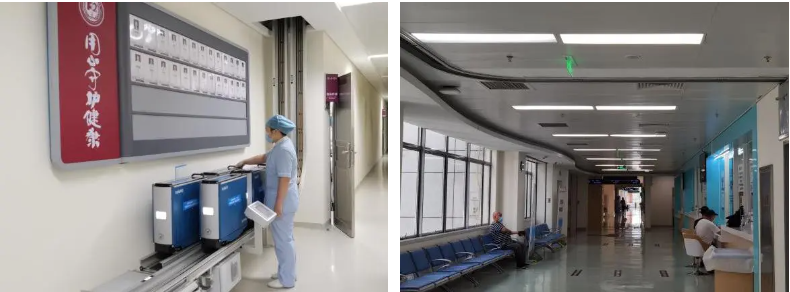
Fuwai Hospital Laboratory Pneumatic Tube System (PTS)
2. Practical Suggestions for Hospital Design with Smart Logistics Systems
Smart logistics systems are now common in new hospitals. As a result, hospital design needs to follow sustainable development principles and carefully consider whether spaces are practical, efficient, and adaptable in the long term.
2.1Plan Early and Design Logistics and Architecture Together
Building a hospital is a large and complex process. It usually includes five stages: project approval, planning and tendering, design, construction, and operation. Smart logistics is part of the hospital’s circulation and supply system. Because items are moved by machines instead of people, logistics routes do not need to follow traditional “human access” rules. They form their own independent system and should be planned separately from the beginning.
Logistics planning should be raised as early as the feasibility study stage. Smart logistics design should run through the whole design process. Key decisions — such as equipment type, main user departments, and system scale — should be clarified early. This helps architects plan layouts, routes, equipment rooms, and station locations more smoothly. Early coordination also avoids later design changes, reduces cost, and improves efficiency.
2.2 Plan Spaces Scientifically for Long-Term Use
Many hospitals are built in phases, so both the building design and logistics system must allow for future expansion.
There are two common upgrade scenarios.
One is adding logistics systems to certain departments in an existing hospital. Clustered or modular layouts work well here because they allow equipment to be added more easily. Departments can reserve station locations and structural openings during the initial design, making future installation simpler.
The other scenario is adding new buildings or new departments to an existing campus. In this case, designers should think ahead about connection points. Phase-one buildings should leave space for future logistics routes that can connect to later expansions.
2.3 Keep Design Flexible for Future Smart Upgrades
Some hospitals may not want to invest heavily in smart logistics at the beginning. Even so, it is wise to leave space for future systems.
Rail-based systems need vertical shafts with suitable size and location. Floor heights must allow enough clear height after tracks are installed above ceilings.
Box-type systems require space for vertical shafts and horizontal transfer floors.
Robot systems are more flexible since they are external equipment and do not change building form much. If robots share corridors with patients, spaces should be wider to avoid crowding. If they run alongside staff, dedicated staff or robot routes are better.
In practice, designers can:
reserve space for equipment rooms, openings, and transfer floors
make hospital streets and corridors slightly wider
avoid low floor heights so future equipment can be installed
Smart logistics is already a standard feature in many new hospitals. It affects overall layout, floor height, corridor width, and reserved equipment spaces. Good hospital design should consider logistics from the start and integrate it with spatial planning. This leads to more efficient operations and helps hospitals adapt to future needs.
Read more:https://mp.weixin.qq.com/s/kNOdyCSUeznxRwmQz93L3A